Antananarivo—Tana, as it’s affectionately called—is a city that takes you by surprise. It’s a mix of old-world charm and modern chaos, with a rhythm that feels uniquely its own. During my 48 hours there, I found myself completely swept up in its history, culture, and, let’s be honest, the quirks that make Madagascar so fascinating.
Day One: Stepping Back in Time
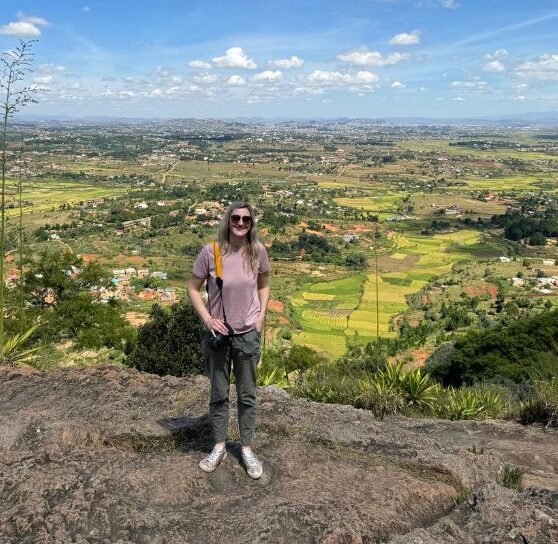
I kicked off my trip with a visit to one of the city’s most well-known landmarks—the King’s Palace. It’s about a 40–45-minute drive from the centre of town, set high up on a hill overlooking Tana. While the term palace invokes a grand vision, it’s rather a humble wooden structure but you can feel the weight of history in every cobbled stone around the building. The northeast corners of the buildings are a sacred spot where you ask for blessings. It’s all tied to Fady (ancient Malagasy taboos and beliefs), which still play a huge role in daily life here.


What made the visit even more special was that it had been Madagascar’s New Year the day before. The celebrations were still fresh in the air, with stories of sacrifices (and evidence in the stones) made to mark the occasion—most notably, the offering of Zebu. And this isn’t just a one-off thing. Throughout the year, locals make smaller sacrifices to honour their ancestors, part of the ongoing cycle of tradition here. It’s remarkable how deep the connection to the past runs.
Later that day, I headed to Rova, the Queen’s Palace. Here I learnt of the fire in 1995 which devastatingly destroyed much of the interior, although this has been carefully and lovingly rebuilt. I stood near the spot where the first flames were seen—it’s hard not to feel a sense of loss. But the fig trees planted around the palace are a beautiful symbol of regrowth, and you get the feeling that Tana, like these trees, always finds a way to come back stronger.


Day Two: Diving Deeper into Tana
The next morning, I set off bright and early, around 8 a.m., to explore more of the city. We made a quick stop by the new train station, which isn’t open yet, but it felt like a glimpse of what’s to come as Tana continues to grow and evolve. As we drove through the city, I couldn’t help but again notice the jacaranda trees —if you’re here in October, you’ll see their vibrant purple flowers adding a touch of magic to the streets.
I also picked up a few key lessons in Malagasy etiquette—don’t point with just one finger, for starters! It’s considered rude, especially when dealing with anything spiritual. Instead, you gesture with your whole hand. Little cultural nuances like this really give you a deeper understanding of the place and its people.


Tana is home to approximately 18 different tribes, each with their own traditions, though many share common beliefs and fully respect each other’s views. One of the more intriguing customs I learned about was the way families celebrate a boy’s coming of age. After a circumcision ceremony, it’s the elder of the family who eats part of the sacrifice, marking the boy’s transition to manhood. While to the western world this feels rather shocking, it’s these kinds of rituals, steeped in history and symbolism, that make Madagascar feel so wonderfully different.
I couldn’t leave without learning more about Madagascar’s famous vanilla. Although it’s not native to the island—it was brought over by the Mexicans—it’s now one of Madagascar’s most famous exports. Pollination is done by hand, due to the lack of wasps to do it naturally. It’s a painstaking process, but it results in some of the best vanilla in the world.


A Special Dinner at La Varangue
For my final night in Tana, I headed to La Varangue —a place that feels more like stepping into a cabinet of curiosity than a restaurant. The courtyard greets you with vintage Land Rovers, trees adorned with lanterns, and twinkling lights, setting the scene for something truly unique. But it’s when you step inside that the real magic happens. Every wall, every surface is covered in an eclectic mix of objects—vintage trumpets, grand clocks, old-fashioned lamps. It sounds chaotic, but somehow, it all comes together perfectly. You feel like you’ve wandered into a collector’s dream, a treasure trove of oddities.
With a live sax in the background, I tucked into a delightful meal. I opted for the zebu steak, a Malagasy specialty, and it was exactly what I’d hoped for—tender, rich, and perfectly cooked. If you’re more of a seafood fan, the giant gambas are a feast for both the eyes and the taste buds.
La Varangue also offers accommodation, and the rooms are a blend of old and new. The newer ones, tucked away down a small flight of steps, are more modern (these would be my recommendation) while the older ones are in the main building and retain some quirky charm.
Spending 48 hours in Tana was an unforgettable experience. The city doesn’t give up all its secrets straight away—you have to take the time to peel back the layers. But once you do, you’re rewarded with a place that’s full of life and history. Whether you’re exploring ancient palaces, learning about sacred traditions, or simply enjoying a meal under twinkling lights, Tana leaves a mark.